You source fifteen candidates whose resumes match every single requirement on the job posting: Python, PostgreSQL, AWS, and Docker. You spend your week scheduling phone screens, taking notes, and forwarding their profiles with high confidence.
By Friday afternoon, the engineering hiring manager rejects twelve of them with a quick Slack message:
*“These candidates only built basic CRUD endpoints; we need someone who understands database locking, connection pooling, and high-throughput ingestion.”*
You did exactly what the job description asked for. So why are candidate rejection rates between recruiting and engineering still hovering near 80%?
In 2026, keyword matching is broken. Candidates use generative tools to tailor their resumes to job descriptions in thirty seconds. At the same time, engineering managers are swamped, leading to frustrated rejections and extended time-to-hire.
The breakdown does not happen during the technical interview. It happens on day one: during the intake calibration meeting.
Here is a practical, four-step framework to translate vague engineering wishlists into observable resume signals—complete with visual diagnostic rubrics you can reference on every hiring call.
The intake calibration matrix: core vs tooling vs scale
Most intake meetings fail because the hiring manager hands over an "Everything Bagel" wishlist: eight programming languages, five cloud platforms, and twelve libraries.
If you screen for all of them, your pipeline stays empty for four months. If you screen for none, you forward the wrong people.
Stop asking the manager: *"What technologies do they need?"*
Ask instead: "What will break if this engineer makes a bad architectural choice in month two?"
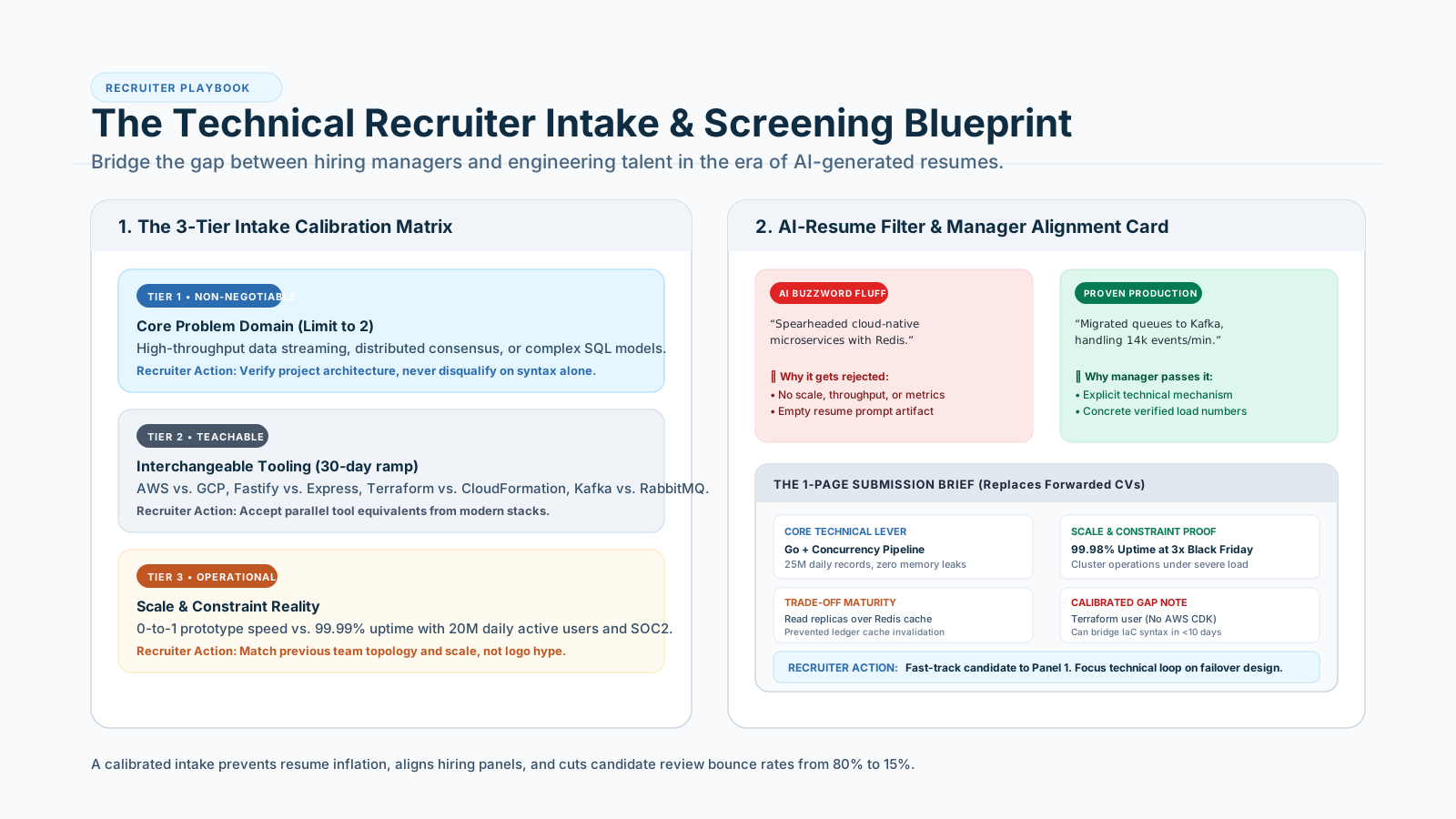
Classify every requirement into the 3-Tier Intake Calibration Matrix:
01 / The 3-Tier Intake Calibration Matrix
Classify hiring manager demands before opening candidate search tools.
Core Problem Domain
The foundational system challenges the candidate must solve daily (limit to 2 max).
Interchangeable Tooling
Vendors and frameworks that an experienced engineer learns within 3–4 weeks.
Scale & Constraint Reality
The actual stage of the product: rapid 0-to-1 prototype vs. high-availability uptime.
1. Tier 1: The Non-Negotiable Core (Limit to 2 Maximum)
This is the foundational problem domain the engineer will solve every day. If the product is a payment ledger, the core is not "Node.js"—it is distributed transaction isolation and concurrency.
If the candidate has never worked with high-concurrency data, no amount of generic JavaScript experience will bridge the gap. Limit Tier 1 to at most two core competencies.
2. Tier 2: The Teachable Tooling (30-Day Ramp)
Specific frameworks, cloud vendors, and database brands are often interchangeable for an experienced engineer. If an applicant has five years of deep PostgreSQL performance tuning, they can master MySQL or DynamoDB nuances within three weeks.
When a hiring manager says *"They must have AWS, not GCP,"* challenge them politely: *“If an engineer architected multi-region Terraform pipelines in GCP with 99.99% uptime, will our team reject them?”* 95% of the time, the answer is no.
3. Tier 3: The Scale & Constraint Reality
This is the hidden reason candidates get rejected by engineering panels. An engineer who built an MVP from scratch in a 4-person seed startup has vastly different reflexes than an engineer who shipped features inside a SOC2-compliant microservice mesh serving twenty million daily active users.
Match your candidate sourcing to the operational environment and team topology, not the company brand name.
The AI-resume authenticity test: buzzwords vs evidence
Because generative AI makes it effortless for applicants to mirror a job description, modern applicant tracking systems are flooded with synthetic keyword density.
Phrases like *"Spearheaded cloud-native microservices"* or *"Leveraged modern best practices"* carry zero diagnostic value. Genuine engineers do not describe their work in generic marketing adjectives; they describe constraints, technical trade-offs, and operational consequences.
Use the signal diagnostic below when reviewing technical resumes:
02 / The Tech Resume Signal Checker
Spotting AI-generated bullet points vs. authentic production engineering evidence.
- •Contains empty buzzwords ("cloud-native") with zero boundaries.
- •No throughput, load, or outcome; sounds directly copied from a prompt.
- •Names the legacy mechanism (cron) and new system (Kafka).
- •Quantified throughput (14k/min) and reliability constraint.
- •Passive phrasing ("responsible for" implies task participation).
- •No engineering levers or baseline performance changes noted.
- •Specifies technical decision: composite indexing on specific table.
- •Understands P95 distribution metrics, not just generic "speed."
The Anatomy of High-Signal Tech Bullets
When reviewing candidate experience, train your eyes to scan for three specific components:
- 1.The Specific Mechanism: Did they just "optimize databases," or did they *refactor compound indices, add PgBouncer connection pooling, or partition historical tables*?
- 2.The Operational Boundary: What were the conditions? *Peak Black Friday traffic, 14,000 webhook events per minute, or 45 million records*?
- 3.The Measured Consequence: Did latency drop from *1.8 seconds to 210 milliseconds*? Did cloud infrastructure cost decline by *30%*?
If every bullet point on a five-page resume reads like a textbook definition without numbers or constraints, treat it as low-signal keyword stuffing.
Recruiter Truth: A senior engineer with authentic experience is proud of what broke and how they fixed it. An AI-generated resume only lists generic successes without operational friction.
The three-question conversational screen without coding trivia
Many technical recruiters dread phone screens because they feel trapped between two bad options: asking awkward syntax trivia from an engineering cheat sheet, or sticking purely to culture questions that tell you nothing about technical depth.
The most effective recruiter screens are neither coding tests nor social chats. They are decision-making autopsies.
You do not need to know how to write code to evaluate engineering maturity. Use the 3-Question Screening Tree:
03 / The 3-Question Recruiter Screening Tree
Listen for ownership signals and trade-off maturity without writing code.
“Tell me about a time you picked Tool A over Tool B. What was the drawback you had to live with?”
“What was the most painful bug or production incident you personally triggered?”
“When your previous system or user base tripled, what was the first component that broke?”
How to Evaluate Candidate Responses
- On Question 1 (The Trade-Off Test): Junior or dogmatic engineers say their chosen tool is "the best" or "industry standard." Senior engineers immediately articulate the price they paid: *"We got faster read speeds, but write throughput degraded by 15%."*
- On Question 2 (The Outage Autopsy): Passive participants blame product managers, QA testers, or cloud outages. Accountable engineers explain the incorrect assumption they made, how their monitoring alerts caught it, and the safeguard they added to prevent repetition.
- On Question 3 (The Bottleneck Probe): Engineers who only built demo apps claim their system scaled effortlessly. Production engineers have battle scars: connection timeouts, race conditions, memory leaks, and CPU spikes.
The one-page hiring manager alignment brief
When you finish screening a strong candidate, never just forward an unannotated PDF to the hiring manager.
A busy engineering lead reviewing a raw PDF will glance at the header for seven seconds, spot a missing secondary framework, and hit reject.
Instead, spend two minutes creating a One-Page Alignment Brief. It highlights the exact criteria you calibrated during the intake meeting:
04 / The 1-Page Hiring Manager Alignment Brief
The debrief format that drops candidate review rejection rates from 80% to 15%.
Go + Event-Driven Systems
Built concurrent ingestion pipeline processing 25M daily transactions with zero memory leaks.
High Concurrency (Black Friday Peak)
Maintained 99.98% uptime across 18 Kafka nodes under 3x baseline traffic bursts.
PostgreSQL Replicas over Redis Cache
Avoided stale cache data on ledger entries by choosing read-replicas over aggressive caching.
No AWS CDK Experience (Used Terraform)
Strong IaC mental models confirmed in screen; can bridge syntax gap within 10 days.
Recommend immediate advance to Technical Panel 1. Focus technical interviewer on multi-region failover.
Why This Format Reduces Rejection Rates
- 1.It proves calibration: The manager immediately sees that you tested for their Tier 1 core problem domain.
- 2.It pre-empts nitpicking: By explicitly noting that the candidate knows Terraform rather than AWS CDK—and clarifying that they can ramp up in ten days—you prevent an instant rejection over minor tooling differences.
- 3.It guides the technical panel: You give the technical interviewers a concrete focus area (e.g., cross-region failover recovery) instead of asking them to start from scratch.
Five pre-flight checks before sourcing begins
Before opening LinkedIn Recruiter or your sourcing pipeline, run this 5-point checklist with your hiring manager:
- 1.Agree on two non-negotiables: Forbid the job description from having more than two Tier 1 core competencies.
- 2.Identify acceptable parallel stacks: Explicitly list equivalent technologies (e.g., GCP = AWS, PostgreSQL = MySQL, Kafka = RabbitMQ).
- 3.Define the scale context in the JD: State current requests-per-second, database record volume, and team size directly in the job description.
- 4.Draft three anchored screen questions: Write down the exact trade-off questions you will ask candidates during phone screens.
- 5.Calibrate on the first three profiles: Review three resumes together within forty-eight hours of opening the role to ensure criteria alignment.
Audit your Job Description with Skiltrio
Skiltrio's AI analyzes your tech job descriptions, detects contradictory requirements, and generates calibrated screening scorecards with anchored interview rubrics in 30 seconds.
Frequently asked questions
How do I push back when a hiring manager demands 10+ mandatory requirements?
Ask them to prioritize the requirements by business risk: *"If we find an engineer who excels at items 1 and 2, but needs three weeks to ramp up on items 5 and 6, should we interview them?"* If they say yes, move items 5 and 6 to Tier 2 (Preferred / Teachable).
Can recruiters accurately screen engineers without a technical background?
Yes. You do not need to evaluate the syntax of code to evaluate how a candidate thinks. Senior engineers communicate trade-offs, acknowledge system constraints, and explain business context simply. Jargon-heavy, defensive answers without substance are universal warning signs.
How does Skiltrio help recruiters calibrate job descriptions?
Skiltrio scans job descriptions for seniority mismatches, ambiguous requirements, and missing team scale signals. It automatically produces role-specific interview rubrics, technical screening questions, and candidate evaluation scorecards so recruiting teams and engineering managers remain aligned throughout the pipeline.