You know React and TypeScript. The job asks for Next.js, AWS, Kubernetes, accessibility, and experience leading frontend architecture.
You could spend tonight tailoring your resume. You could also spend it applying somewhere else.
Counting the tools you recognise won’t settle that decision. Missing one central responsibility can matter more than missing three supporting technologies. Equally, a tool you haven’t used may sit beside work you already know how to do.
The useful question is: Can I show evidence for the work this role needs—and explain the gaps honestly?
Here’s a practical way to answer it using one fictional frontend role.
Start with what you would actually own
Consider this fictional job description:
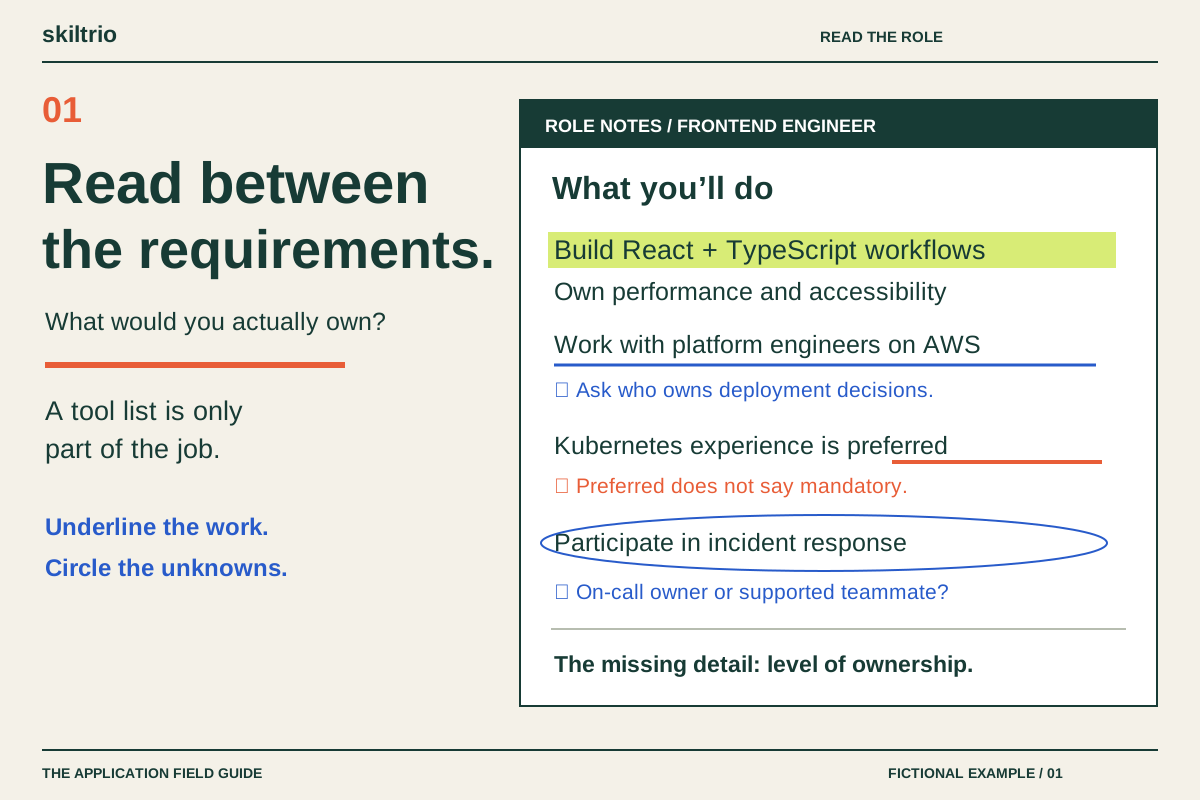
Build customer-facing workflows with React, TypeScript, and Next.js. Own frontend architecture, performance, and accessibility. Work with platform engineers on AWS deployments. Kubernetes experience is preferred. Participate in production incident response.
Now consider a fictional candidate, Maya. She has built React and TypeScript applications, improved keyboard navigation, and investigated slow page interactions. She has tried Next.js in a side project. A platform team handled deployment. She has fixed bugs reported from production but has not owned on-call incidents.
A keyword checklist makes this look like several matches and several misses. Reading the responsibilities reveals a different question: how much independent production ownership does this role require?
Before comparing yourself with the stack, finish this sentence:
“This person is being hired to own ______.”
For this example: customer-facing frontend delivery, architectural decisions, and the reliability of that experience. The deployment boundary is still unclear.
Make an evidence map, not a match percentage
Use four columns. Keep the evidence specific enough that you could discuss it in an interview.
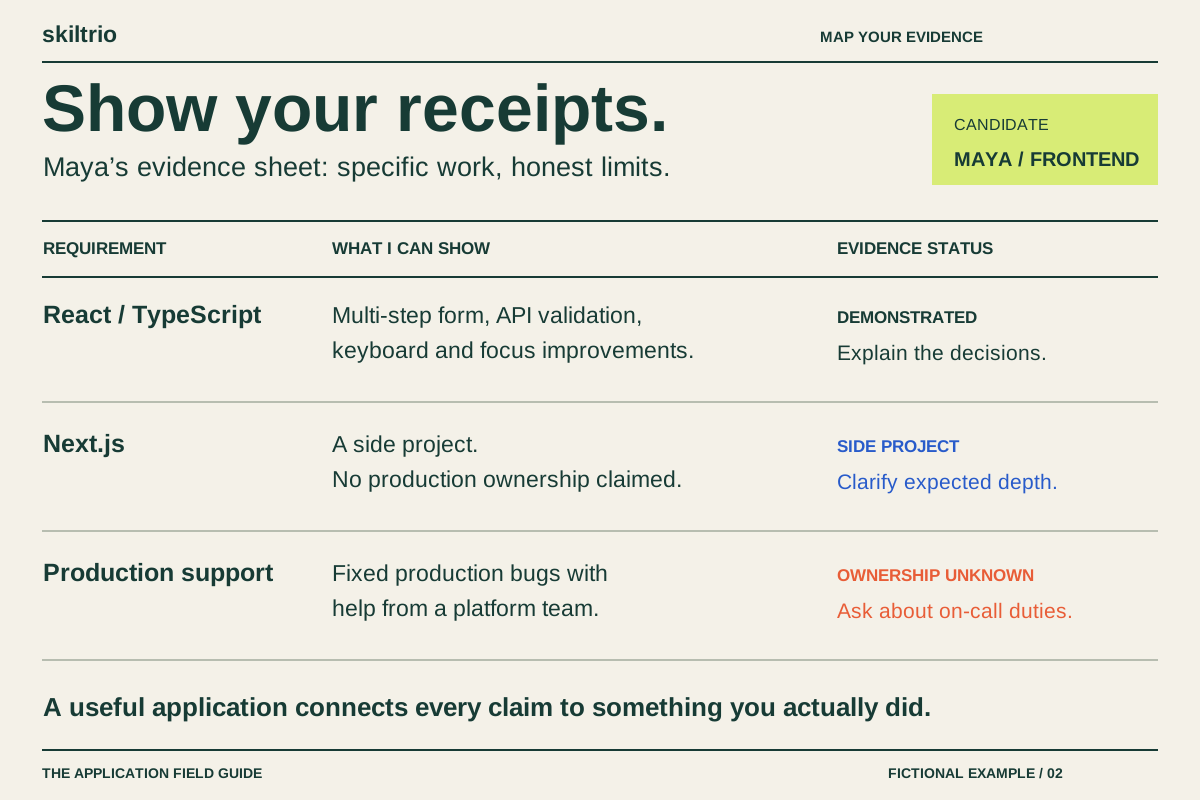
| Requirement | Maya’s evidence | Gap or uncertainty | Next step |
|---|---|---|---|
| React and TypeScript workflows | Built a multi-step form with validation and API integration | No obvious gap for this responsibility | Describe the implementation and decisions |
| Accessibility | Improved keyboard navigation and focus handling | Broader audit experience is unclear | State the scope of the work accurately |
| Next.js | Side project only | No production experience with its rendering and deployment choices | Disclose the gap; ask how central Next.js ownership is |
| AWS collaboration | Worked with a platform team | Expected deployment ownership is unclear | Ask who owns infrastructure and releases |
| Kubernetes preferred | No direct experience | Explicitly listed as preferred | Note the gap without making it the whole decision |
| Incident response | Fixed production bugs | Has not independently owned on-call incidents | Ask about escalation, support, and expectations |
This table does something a single score cannot: it separates what you can demonstrate, what you lack, and what the employer needs to clarify.
“Unknown” deserves its own treatment. Don’t quietly convert it into either “I can do this” or “I’m unqualified.”
Distinguish a learning gap from an ownership gap
A learning gap concerns knowledge or a tool you haven’t yet used at the required depth. Maya’s Next.js experience belongs here, although its importance depends on the role. React experience is relevant; it doesn’t automatically establish competence in server rendering, caching, or deployment.
An ownership gap concerns responsibility you haven’t yet carried. Designing an approach independently, making a release decision, or coordinating an incident involves more than knowing a framework’s API.
Neither category is automatically acceptable or disqualifying. The distinction helps you ask a better question:
“Would I be learning within a supported team, or be expected to lead this work immediately?”
For Maya, a team with platform support and shared incident response could be a different opportunity from a role where she is the sole frontend owner and primary incident responder. The same stack can describe both.
“They want five years. I have three.”
A years-of-experience requirement can signal the level of independent ownership a team expects. If you have three years of experience and can demonstrate the architectural decisions and responsibility described in a five-year role, make that evidence explicit. An employer may still enforce the stated minimum, so report your actual experience accurately and treat flexibility as something to clarify, not assume.
Choose: apply, clarify, or pass
There is no universal percentage of requirements that makes an application worthwhile. Use the responsibilities and your evidence to choose a next step.
Apply when you can demonstrate the central work, meet the stated eligibility constraints, and explain the remaining gaps without hiding them. You don’t need to claim that every unfamiliar technology will be easy.
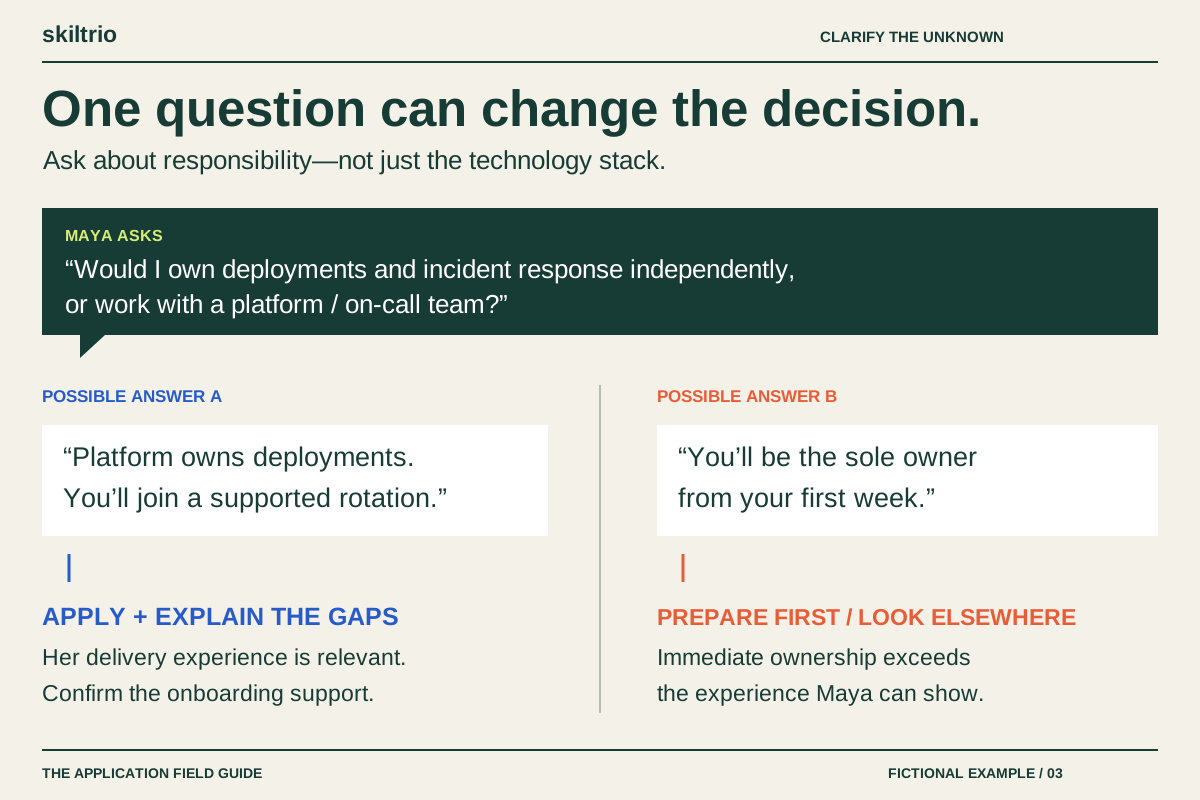
Clarify when one unanswered question could change your decision. For Maya, that question is the scope of independent production ownership. Here is how she could phrase it:
“I’ve delivered React/TypeScript workflows and worked on accessibility and performance. My Next.js experience is from a side project. Could you clarify whether this role independently owns deployments and incident response, or works with a platform/on-call team?”
Where should that question go?
- In the application: If there is a cover-note or open-question field, keep it brief: “Could you clarify whether deployment and incident response are independently owned or shared with a platform team?” An ATS form without such a field doesn’t require you to find another inbox.
- In the initial screen: Make it your main question when the recruiter invites questions. If they don’t know the technical detail, ask to discuss it with the hiring manager in the next conversation.
- In direct outreach: Use a warm contact or an identifiable hiring manager for the specific role. Keep the question focused, and don’t wait for a reply before applying if the role otherwise looks suitable.
Treat “clarify” as a question to carry into the application process, not a requirement to obtain permission before applying.
Pass or prepare first when the role’s central responsibility is something you cannot yet support with evidence and the team explicitly needs immediate independent ownership. Also take clear location, schedule, and other eligibility constraints seriously.
For this fictional example, Maya can apply and clarify the ownership expectations during screening. She has relevant delivery experience; the unanswered question is whether the level of independent responsibility fits her experience.
Tailor the evidence without upgrading the facts
Once you decide to apply, use the map to choose which experience deserves space on your resume.
Suppose Maya can truthfully support the form and keyboard-navigation work described above.
Before: “Worked on frontend development using React.”
After: “Built a multi-step React/TypeScript form with API validation, and improved keyboard navigation and focus handling.”
The second version makes the evidence easier to assess. It doesn’t invent a conversion increase, call the work WCAG-compliant, or turn a side project into production experience.
Use the same discipline with unfamiliar tools. “Explored Next.js in a side project” is a clearer claim than adding Next.js to an undifferentiated list beside technologies you have used professionally for years.
Use AI to organise the comparison, then check its reasoning
Skiltrio offers job-description analysis and resume-to-JD comparison. You can use those outputs as a starting point for this evidence map.
Check the analysis against the original documents:
- Did it treat a preferred skill as mandatory?
- Did it recognise relevant experience that uses different wording?
- Did it infer ownership or expertise your resume doesn’t actually demonstrate?
- Did it highlight a missing tool while overlooking a central responsibility?
An AI assessment cannot tell you whether a hiring team will shortlist you. It can help organise the information you use to decide where to invest your effort.
Your next application: four questions
Before rewriting your resume, write down:
- 1.What would I be expected to own?
- 2.What have I done that demonstrates that ability?
- 3.Which gap or unanswered question could change my decision?
- 4.Will I apply, clarify, or prepare first—and why?
You may still decide to stretch. The difference is that you’ll know what you’re stretching toward.
Try analysing one job description with [Skiltrio](https://www.skiltrio.com/), then use the worksheet below to check the findings against your actual experience.
Your reusable application worksheet
The completed table earlier in this article shows Maya’s example. The template below is intentionally blank: copy it and add your own evidence, keeping side projects distinct from professional work.
Role / company: ____________________
What would I be expected to own? ____________________
| What does the role require? | What have I actually done? | What is missing or unclear? | What will I do or ask next? |
|---|---|---|---|
The question that could change my decision: ____________________
Where I will ask it: Application note / initial screen / relevant direct contact.
My next step and reason: ____________________
Maya’s final decision
“I’ll apply with evidence of my React/TypeScript delivery, clearly label Next.js as side-project experience, and ask about deployment and incident ownership in the initial screen. A supported role may be a sensible stretch. If the team needs an independent owner from day one, I’ll look for a role closer to the responsibility I can currently demonstrate.”