Consider a common resume bullet found across software engineering applications:
Spearheaded the development of scalable microservices using cutting-edge technologies to enhance performance by 35%.
At first glance, it sounds productive. But when an interviewer or engineering manager reads it, questions immediately arise: What baseline was that 35% measured against? Why were microservices necessary instead of optimizing the existing codebase? What trade-offs were accepted?
In high-volume hiring environments, dozens of applicants submit nearly identical claims. Modern AI tools can easily draft polished, authoritative-sounding paragraphs for any technical topic. As a result, hiring teams have grown cautious around broad adjectives and context-free percentages.
What actually stands out is defensibility: can you clearly explain the constraint you faced, the engineering decision you made, and how you verified that the solution worked?
Illustrative Examples: The bullets in this guide are teaching models. Use only details you can substantiate, be transparent about your personal contribution on team projects, and use approved approximate ranges rather than confidential company data.
The core formula: constraint, decision, and verification
Most resume guides recommend the classic structure: Accomplished [X], as measured by [Y], by doing [Z].
Use this structure without forcing a numerical result when you lack reliable measurements. In day-to-day engineering, your contribution is often defined by resolving technical constraints, reducing operational risk, and preventing failures.
To write bullets that survive technical scrutiny, use this three-part framework:
From problem to evidence
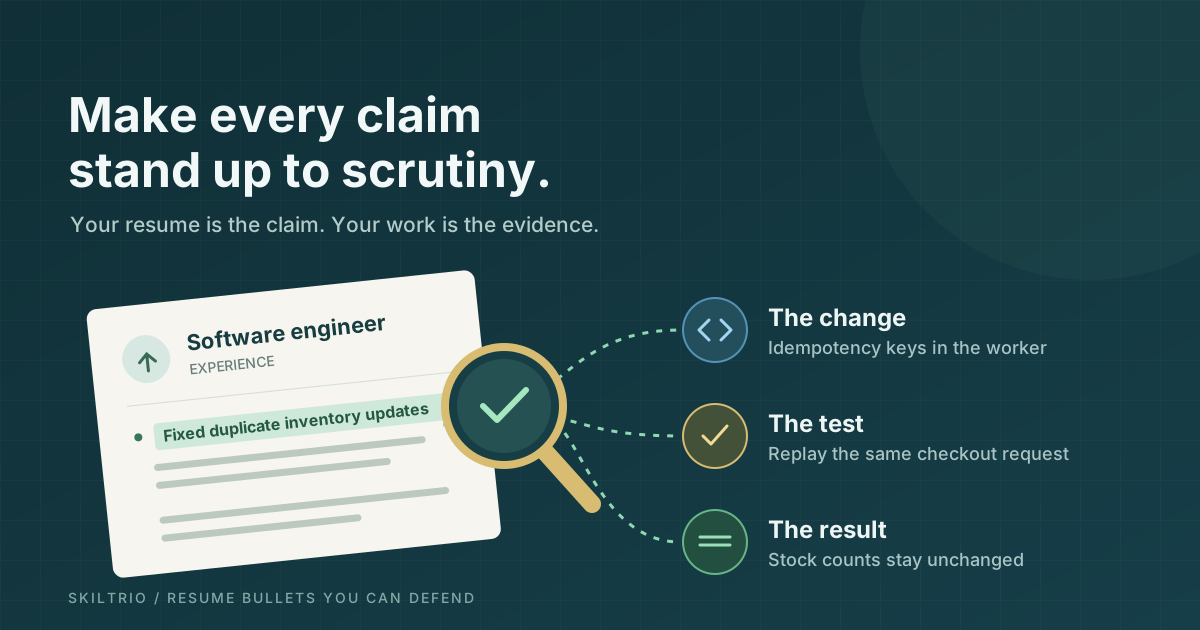
One checkout. Two requests. One inventory update.
1. Checkout is retried
Both requests carry the same order key.
2. Worker checks the key
Record the key alongside the stock update; skip an already processed request.
3. Replay confirms the result
First request: stock 10 → 9. Retry: stock stays at 9.
The resulting resume bullet
Prevented duplicate inventory updates during checkout retries by adding idempotency keys to the worker; verified unchanged stock counts after request replay in integration tests.
1. The Constraint (The Operating Reality)
Name the technical limitation, data scale, concurrency level, or legacy boundary you worked within. Engineering is inherently about solving problems under constraints:
- On a PostgreSQL table with 140M rows experiencing 2.4s lock contention during hourly batch runs…
- Inherited a monolithic frontend with no component-level test coverage…
2. The Decision (The Technical Mechanism)
Explain the concrete action you took and the trade-off it involved. What did you choose to build, and what alternative did you reject?
- …introduced zero-downtime table partitioning with dual-writing rather than taking an offline maintenance window…
- …standardized state access through scoped selectors instead of top-level context providers…
3. The Verification (The Observable Outcome)
Describe how you confirmed that the change succeeded, whether through telemetry, error rates, or completed milestones:
- …reducing p99 query latency to 42ms with zero data discrepancies over three billing cycles.
- …unblocking six product teams to deploy updates independently without shared state regressions.
When your bullets are anchored in real project context, they provide natural, constructive starting points for your technical interviews.
Why vague technical claims fall apart under questioning
Large language models can easily generate plausible-sounding architecture stories. Citing specific tools does not prove you understand them; rather, specificity gives an interviewer something concrete to examine.
Consider what happens during a 45-minute technical screen when a candidate includes a generic claim:
Candidate bullet:
Architected high-throughput message streaming with Kafka, optimizing system throughput.
Interviewer follow-up:
What partition key strategy did you use, and how did your consumers handle rebalancing during traffic spikes?
If the candidate simply installed a client library following a quick tutorial, the conversation stalls quickly.
Conversely, when a bullet reflects work you genuinely participated in—even routine maintenance, operational debugging, or refactoring—you can comfortably discuss:
- What trade-offs your team debated.
- What broke in staging or testing before you got it right.
- Why a simpler alternative was insufficient.
Interviewers do not expect every engineer to have built distributed databases from scratch. They look for evidence that you understand the operational implications of the code you write.
Side-by-side comparison: vague bullets vs defensible evidence
Here is how the constraint-decision-verification framework transforms ambiguous bullet points across common engineering domains:
Side-by-Side: Vague Bullets vs. Defensible Evidence
Spearheaded microservices transition using Go, Docker, and Kafka, boosting system throughput by 45% and optimizing developer velocity.
- No baseline provided (45% of what volume or latency?)
- Buzzword laundry list ('spearheaded', 'developer velocity')
- Fails to explain why microservices were needed over the existing architecture
Isolated payment ledger into an event-driven Go service to resolve database deadlocks at 3,200 checkout req/sec; implemented transactional outbox with Kafka and consumer idempotency keys, preventing duplicate ledger entries with 0 reconciliation errors over 12 months.
- Identifies specific failure mode (database deadlocks at 3,200 req/sec)
- Articulates the architectural pattern (outbox with consumer idempotency keys)
- Concrete operational outcome (0 reconciliation errors across 12 months)
What Changes Between the Two?
Look closely at what makes the defensible bullets work:
- The vague version lists technologies in the abstract (microservices transition using Go, Docker, and Kafka) and asserts a 45% throughput gain without specifying the starting throughput, latency profile, or why microservices were needed over the existing architecture.
- The defensible version specifies the actual operational trigger (database deadlocks during peak 3,200 req/sec checkout traffic), explains the architecture chosen (transactional outbox with Kafka alongside consumer idempotency keys), and cites verified stability (zero ledger reconciliation errors over 12 months).
When an interviewer reads the defensible bullet, they have an immediate technical anchor: they can ask how you chose your partition keys, how consumer deduplication was implemented, or how database locks were diagnosed.
When to keep bullets concise
The constraint-decision-verification formula is an editing checklist for when technical context is missing—not a mandate to turn every routine task into a distributed systems saga.
Not every engineering contribution involves an architectural trade-off or a production fire:
- Routine feature delivery, library upgrades, security patch maintenance, and unit test expansion are essential daily work.
- It is completely appropriate to write a concise, direct bullet: Maintained Stripe billing integration, updating API version bindings and adding test coverage for failed webhook retries.
- Reserve detailed constraint-and-decision framing for the 2 or 3 core projects where you made significant technical decisions or solved ambiguous problems.
Stop the 30-skill laundry list: tiering your tech stack
A common resume pitfall is listing dozens of languages, libraries, and cloud services in a single block:
Technologies:
Go, TypeScript, Python, Java, Rust, C++, React, Next.js, Node.js,
Kubernetes, Docker, Kafka, Redis, PostgreSQL, MongoDB, Cassandra,
AWS (EC2, S3, RDS, Lambda, SQS), GCP, Terraform, GraphQL, gRPC...
When a reviewer sees 30 distinct technologies listed across three or four years of experience, it creates uncertainty: Which tools do you know deeply, and which have you only encountered in passing?
If you list a technology as a core proficiency, interviewers will expect you to discuss operational trade-offs, debugging approaches, or architectural choices appropriate to that level. Being unable to explain tools listed as primary skills weakens credibility across the resume.
Instead, organize your skills into three clear tiers:
The 3-Tier Tech Stack: Organizing for Credibility
Structure your skills clearly so hiring teams understand your core focus and working context.
3 to 5 technologies you work with deeply
You know common failure modes, profiling tools, internals, and trade-offs. You can comfortably discuss architectural decisions around them.
Tools you have shipped and maintained in production
You can write idiomatic code, troubleshoot issues, and navigate documentation autonomously, without claiming deep systems-level mastery.
Libraries or systems you have evaluated or collaborated with
Reviewed PRs, built prototypes, or worked alongside teams using them. Clear scoping here builds immediate credibility with senior interviewers.
This tiered presentation signals maturity. It tells hiring teams where you can contribute immediately with minimal ramp-up, and where your knowledge represents working familiarity.
Writing strong bullets without performance or revenue metrics
One of the most frequent challenges engineers face is lacking access to formal business metrics or production telemetry:
I worked on internal tooling, legacy migrations, or routine features. Our team didn't track percentage improvements or revenue impact. How do I demonstrate value without inventing numbers?
You do not need to fabricate metrics to write compelling bullets. In fact, reviewers often view claims like increased revenue by 22% with skepticism for individual contributor roles.
Instead, focus on qualitative verification, operational scope, and reduced friction:
1. Documented Scope and Architectural Alignment
- Authored an Architectural Decision Record (ADR) establishing error-handling standards, standardizing API error contracts across participating services.
- Led technical spike evaluating gRPC vs. OpenAPI for mobile-backend synchronization, presenting trade-offs and recommendations to senior staff.
2. Completed Migrations and Deprecations
- Migrated mobile client authentication from an unmaintained custom basic-auth implementation to standardized JWT bearer tokens with refresh rotation, verified against internal security audit requirements.
- Decommissioned legacy v1 billing webhooks after auditing downstream subscriber logs and routing active traffic to v2 endpoints, verified through zero broken client integrations.
3. Defect Elimination and Test Coverage
- Fixed an inventory synchronization race by locking affected database rows and adding a concurrent-checkout regression test.
- Refactored shared UI navigation components to resolve customer-reported accessibility defects and comply with WCAG 2.1 AA guidelines.
4. Process and Developer Friction Reduction
- Consolidated fragmented onboarding setup scripts into a single containerized development environment, eliminating manual configuration steps for incoming engineers.
- Introduced pull request templates and pre-commit linting hooks to enforce consistent error-handling conventions across the team.
These examples demonstrate sound engineering habits: thorough investigation, clear communication, robust testing, and attention to operational detail.
Demonstrating judgment without senior-level tenure
If you are an early-career developer or transitioning into engineering, you might worry that you lack complex production stories.
Avoid the temptation to compensate by writing inflated claims. Interviewers evaluate junior and mid-level engineers on curiosity, foundational understanding, and learning velocity.
You can demonstrate genuine engineering judgment through focused, realistic work:
- 1.Build a well-scoped service with rigorous testing: Rather than a sprawling full-stack clone with shallow implementations, build a smaller, focused application. Write thorough unit and integration tests, document API error cases, and include a clear
READMEdetailing the architectural choices and known limitations. - 2.Profile and benchmark real performance: Measure your application's behavior under simulated load. Document how latency changes as database records scale, and explain what index or caching strategy you introduced to address bottlenecks.
- 3.Contribute to established open-source projects: Find open issues in open-source tools or libraries you use. Writing a targeted bug fix, improving test coverage, or updating developer documentation demonstrates collaborative habits and code-review maturity.
A well-documented, tested project with honest reflections on trade-offs is far more convincing to an engineering panel than a generic project claiming enterprise-scale complexity.
Understanding ATS filtering and human review
Candidates often ask whether focusing on defensibility will hurt their chances with Applicant Tracking Systems (ATS).
The reality is nuanced:
- ATS configurations vary widely: Some employers use automated keyword filtering based on specific job-description requirements; others use semantic search or route all applications directly to human recruiters and sourcers.
- Keywords should be woven into context: Preserving standard terminology (e.g., PostgreSQL, TypeScript, REST API design) is important for keyword matching. Placing those keywords inside descriptive, constraint-backed sentences preserves relevant keywords while giving reviewers useful context.
- Write for human review: While an ATS or recruiter screening may check for relevant keywords, an engineering manager or interviewer evaluates the substance of your work. Writing defensible bullets helps reviewers assess your actual experience and prepares you for technical interviews. While hiring decisions also depend on team level, specific skill match, and organizational fit, concrete evidence gives hiring teams confidence in your technical background.
The 5-point defensibility checklist
Before submitting your resume for an engineering role, review your key bullet points against this checklist:
The 5-Point Defensibility Checklist
Run this audit on your key bullets before submitting to engineering roles.
The Specificity Test
Question: Does this bullet describe an actual problem or operational condition, or is it a generic claim that could apply to any codebase?
Add the baseline, failure condition, operational constraint, or verified resolution.
The Defensibility Test
Question: If an interviewer asks 'Why did you pick this approach over a simpler alternative?' can you speak comfortably about your choices for 5 to 10 minutes?
Anchor every bullet to decisions and technical trade-offs you personally participated in or owned.
The Buzzword Scrub
Question: Are you relying on inflated verbs like 'spearheaded', 'leveraged', or 'championed' without concrete actions?
Replace filler verbs with clear technical actions: diagnosed, profiled, partitioned, migrated, refactored.
The Verification Check
Question: How did you know the change succeeded without breaking upstream consumers or users?
Mention the verification mechanism: staging shadow runs, canary gates, load tests, or zero regression incidents.
The Role Alignment Check
Question: Does your resume reflect the core engineering challenges emphasized in the target job description?
Align your top experience bullets with the primary operational or architectural priorities outlined in the posting.
Analyze your target job description with Skiltrio
Identify the primary technical responsibilities, architectural priorities, and evaluation rubrics in any job description to align your real project experience with what hiring teams care about.
Frequently asked questions
How many bullets should I include per role?
For your most recent or relevant roles, aim for 3 to 5 substantive bullets that highlight different aspects of your work (e.g., core feature delivery, operational maintenance, performance, and cross-team collaboration). For older or less relevant roles, 2 to 3 concise summary bullets are usually sufficient.
Should I rewrite my resume for every application?
You do not need to create an entirely new resume for each job. Instead, identify the two or three primary technical priorities emphasized in the target job description. Ensure your top experience bullets highlight your most relevant, defensible work in those specific areas.
What if my project didn't achieve its original goal?
Engineering projects sometimes change scope or fail to meet ambitious milestones due to shifting business priorities or unforeseen constraints. If you can clearly articulate what you learned, what architectural trade-offs emerged, and how you responded constructively, that discussion can be a strong signal of maturity in an interview.
The Takeaway
A successful engineering resume is not a list of technologies or an exercise in corporate marketing. It is a record of how you solve problems under constraints.
Focus on the decisions you personally made, the boundaries you navigated, and the evidence you can speak to comfortably. When your resume is built on defensible facts, you walk into every technical interview prepared to stand behind your work.