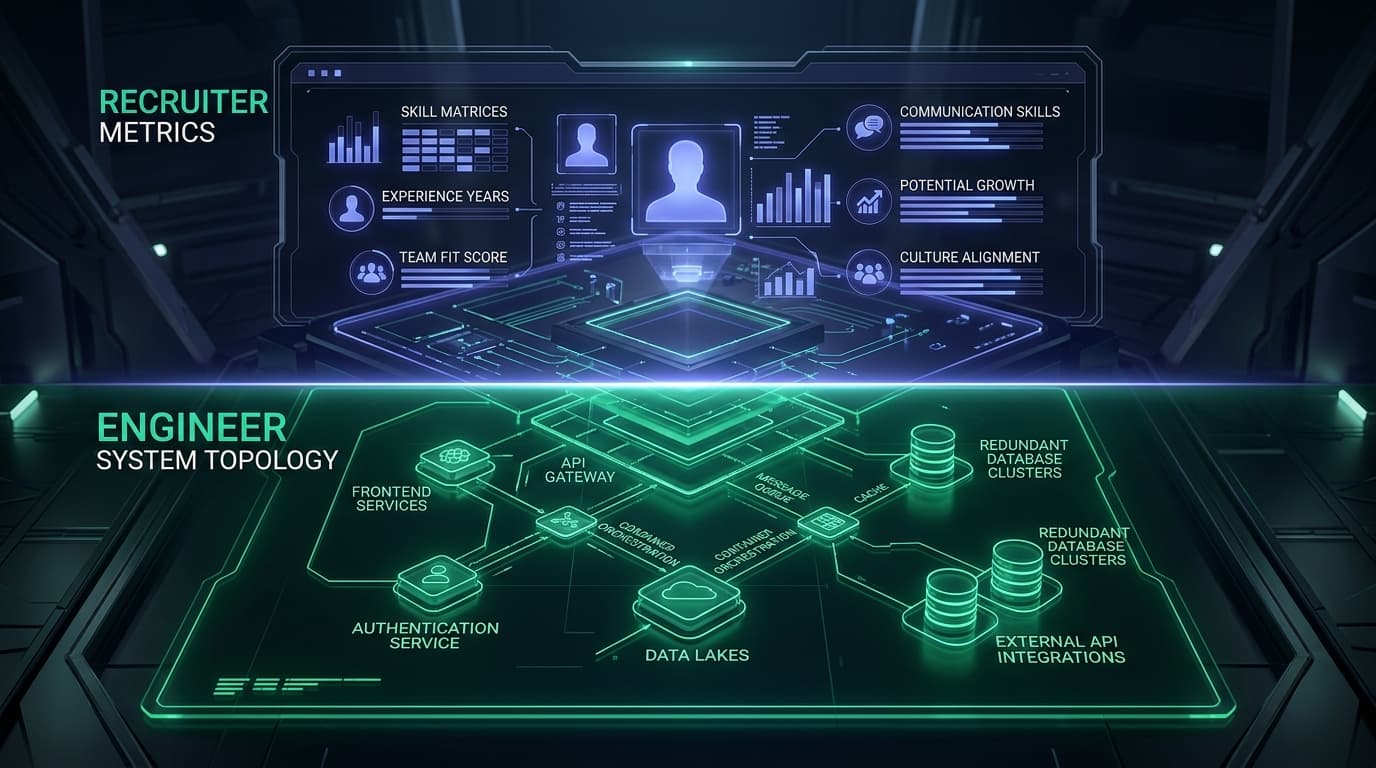
Almost every developer has experienced the frustration of submitting a well-crafted resume to a job opening, only to receive an automated rejection letter forty-five minutes later.
The widespread advice online tells you to "keyword stuff" or paste white text into your PDF. In 2026, those tactics do not work—and in fact, modern parsers (like Greenhouse, Ashby, and Workday) immediately flag those files.
Here is how modern ATS parsers actually interpret your technical experience—and how to align your resume with what recruitment engines look for.
1. The Evolution of ATS: Beyond Keyword Matching
Legacy parsers (from 2015 to 2020) were glorified string matchers: if the JD had "Docker" five times and your resume had "Docker" five times, you ranked near the top.
Modern ATS engines parse semantic entity graphs. They understand relationships between concepts:
- If you list Next.js, the parser infers familiarity with React, TypeScript, and Server-Side Rendering.
- If you list Kafka, the engine looks for companion technologies like Zookeeper, event streaming, or distributed data pipelines.
Simply dropping twenty technology keywords into a "Skills" box at the bottom of page two carries very little mathematical weight.
2. The 'Recency Penalty' Explained
ATS ranking algorithms assign a dynamic time-decay penalty to technical skills:
| Skill Placement | Weight Assigned | Interpretation |
|---|---|---|
| Current / Last Role (0–2 yrs) | 100% Weight | Active, production-grade proficiency |
| Previous Role (2–5 yrs ago) | 60% Weight | Proficient, but may need ramp-up |
| Older Roles (5+ yrs ago) | 20% Weight | Legacy knowledge; penalty applied if primary requirement |
If a job description demands Kubernetes as a core daily requirement, but you only used Kubernetes four years ago at a previous employer, an automated screener will score you significantly lower than a candidate using it in their current role.
Engineering Tip: If you have recent hands-on experience with a tech requirement through open-source contributions, homelabs, or internal migrations, make sure it is explicitly dated within your current experience section.
3. Contextual Association vs. Keyword Stuffing
The strongest signal an ATS parser registers is action verb + technical stack + measurable business impact.
# Weak (Low Semantic Score):
- Responsible for working with PostgreSQL database and APIs.

# Strong (High Semantic Score):
- Architected PostgreSQL partitioning strategy for 45M transaction records, reducing query execution time from 1.4s to 85ms.
Notice the structural difference: the strong bullet associates the tool (*PostgreSQL*) with an engineering discipline (*partitioning*), a data scale (*45M records*), and a quantified outcome (*1.4s to 85ms*).
4. Signals ATS Engines Use for Seniority
How does an algorithm know if you are Junior, Mid-level, Senior, or Staff? It analyzes your bullet points for specific architectural verbs:
- Junior / Mid Signals: *Implemented, fixed, wrote, created, tested, maintained, supported.*
- Senior / Lead Signals: *Architected, spearheaded, audited, decoupled, negotiated, benchmarked, mentored.*
When applying for Senior roles, your bullet points must reflect technical ownership and architectural decision-making, not just task completion.
5. Five Practical Fixes Before Applying
- 1.Mirror the JD's exact naming conventions: If the JD writes *"TypeScript"*, do not write *"TS"*. If it writes *"Amazon Web Services"*, include both *"AWS"* and *"Amazon Web Services"*.
- 2.Anchor skills to concrete deliverables: Never list a technology in your header unless it appears in at least one bullet point describing what you built with it.
- 3.Export in standard, machine-readable formats: Use clean single-column layouts with standard fonts (Lato, Inter, Helvetica). Avoid multi-column graphical canvas layouts that confuse PDF tokenizers.
- 4.Remove outdated frameworks: Deprecate tools that trigger negative recency scores unless explicitly requested in legacy enterprise roles.
- 5.Run a dual-perspective match check: Test your resume against the target JD before submitting.
Check your resume against any Job Description with Skiltrio
Skiltrio's Developer Mode compares your resume directly with target JD expectations, computes your ATS keyword coverage score, and highlights missing system design signals.